Introduction: Carbon Accounting Standards
Within carbon accounting, especially concerning soil carbon, the precision and integrity of data is crucial. Agricarbon’s methods are designed for companies, project developers, and landowners who need high-integrity data for their soil carbon accounting projects.
This article delves into the nuances of detecting change in soil carbon at different scales of the project, drawing from Agricarbon’s comprehensive guide on the subject.
Agricarbon’s Role in Advancing Soil Carbon Measurement
Agricarbon is a leader in cost-effective, highly accurate direct measurement of soil carbon stocks. Our services enable widespread monitoring of soil carbon content, supporting farming practices that capture and store carbon and contribute to a low-carbon food supply chain worldwide.
Understanding the Complexity of Soil Carbon Measurement
Soil carbon measurement is a sophisticated end-to-end process that requires balancing cost and data integrity. Key to this process is the concept of sampling intensity, which significantly impacts the ability to detect changes in the soil carbon stocks and hence, the integrity of carbon removal reporting.
The Science Behind Detecting Change in Soil Carbon
Detecting change in soil carbon involves a detailed understanding of various aspects:
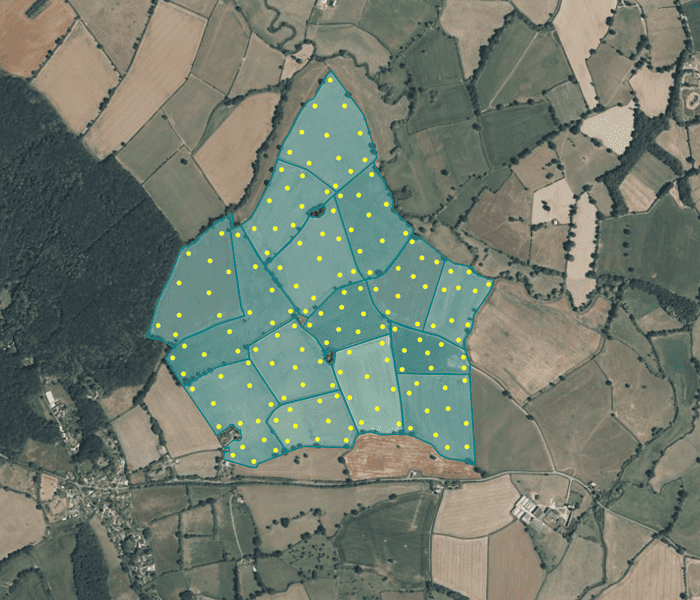
- Variable Soil Carbon: The variability in soil organic carbon and the carbon sequestration potential of soil, necessitates a tailored approach to validate change and determine the required number of data points.
- Data Points Collection: The accuracy of the data is related to the number of data points (soil cores) collected.
- Statistical Significance: For carbon accounting, it is critical to demonstrate that statistically significant difference in soil carbon stocks from a baseline to a remeasurement (typically 3-5 years apart).
Agricarbon’s expertise lies in applying statistical analysis to predict the necessary sample number needed to validate target increases in carbon tonnes per hectare.
Sampling Strategy at Different Project Scales
Agricarbon’s guide outlines various measurement scales, each with its unique pros and cons:
- Project Level: Suitable for detecting change across a large area but may lack the detail for individual farm-level changes.
- Cluster or Cohort Level: An intermediate approach that balances cost and detail, suitable for groups of farms with similar characteristics.
- Farm Level: Enables detection of change for individual farms but requires more intensive sampling.
- Field Level: Intended for research projects focusing on specific fields or plots, offering robust outcomes for experimental purposes.
Agricarbon – Your Partner in High-Integrity Soil Carbon Accounting
For professionals seeking advanced, reliable data for soil carbon projects, Agricarbon’s approach provides an unparalleled blend of accuracy, cost-effectiveness, and scientific integrity. This expertise is instrumental in supporting global actions to protect and restore soils for future generations.
Download Agricarbon’s Comprehensive Guides
For a deeper dive into Agricarbon’s methodologies and insights on soil carbon accounting, statistical significance, and MRV Protocols, download our collection of guides below. These resources offer strategies for accurate soil carbon measurement, tailored for professionals in the field.
Gain Access to
Agricarbon’s Definitive Guide
Read More:

Tags
